Fabric knowledge / Shirting
Poplin, twill and Oxford: understanding the fabric behind the shirt.
An introduction to three widely used shirting fabrics, how they differ and what to consider when choosing between them.
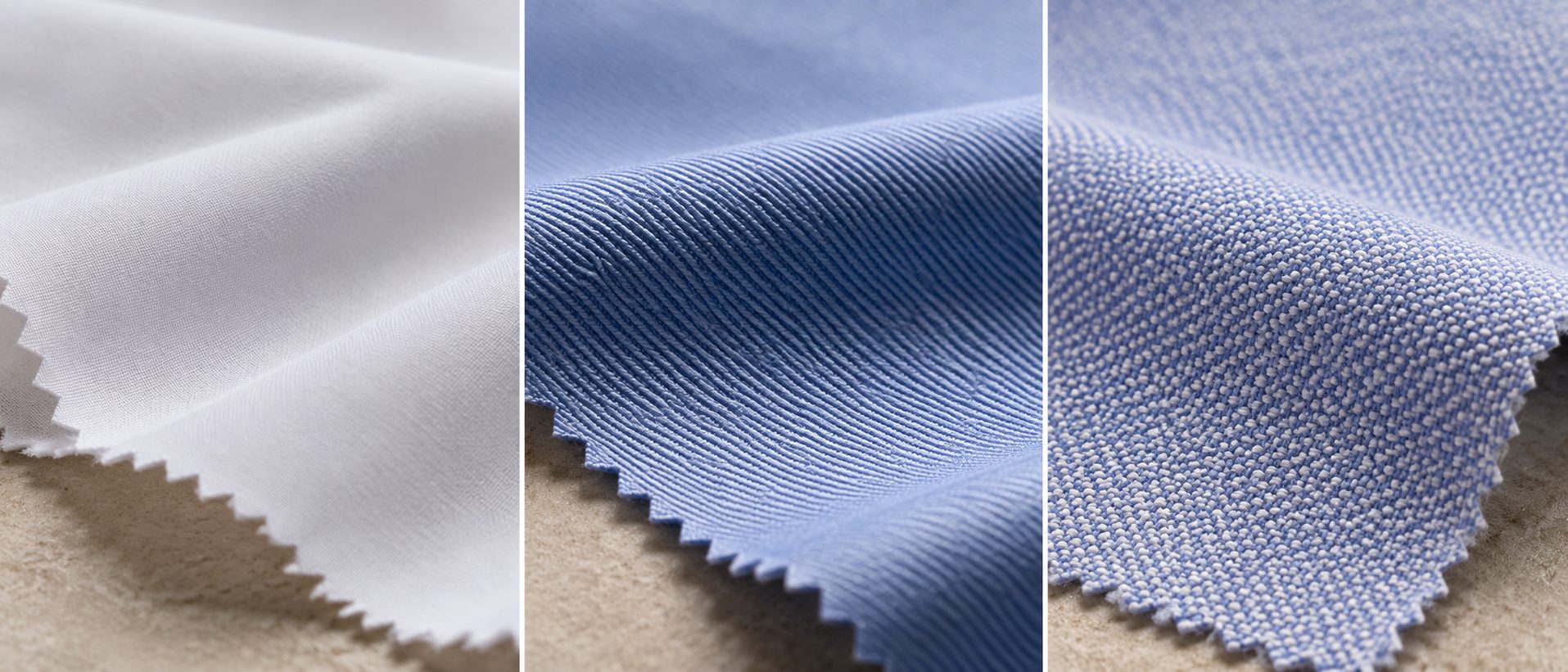
A shirt's appearance is shaped by more than its colour, fit or fibre composition. The way its fabric is constructed plays an equally important role.
Two shirts may both be labelled 100% cotton, yet feel and behave quite differently. One might have a smooth, crisp surface, another a soft diagonal texture, and a third a more substantial, slightly textured character. Often, the difference lies in the weave.
Among the most familiar woven fabrics used in men's shirting are poplin, twill and Oxford. Each offers distinct characteristics, making it suitable for different styles, preferences and applications. Understanding these differences is a useful starting point when selecting fabric for a garment.
What is a fabric weave?
In woven textiles, two sets of yarns intersect to create the fabric. The lengthwise yarns are called the warp, while the yarns running across the width are called the weft.
The way these yarns interlace determines the weave structure. That structure influences the fabric's surface, drape, appearance and certain aspects of its performance.
However, weave is only part of the picture. Fibre quality, yarn count, yarn twist, fabric density and finishing processes also contribute to the final result. This is why two fabrics with the same weave can still feel noticeably different.
Poplin: smooth, clean and understated
Poplin is commonly associated with fine, closely constructed plain-weave fabrics. In a plain weave, the weft yarn passes alternately over and under successive warp yarns, producing a relatively even surface.
Cotton poplin is widely used for business and formal shirts because of its smooth appearance and clean finish. Its relatively flat surface makes it particularly suitable for solid colours and fine patterns.
Typical characteristics
- Smooth, relatively uniform surface
- Clean, crisp appearance
- Available in lightweight and more substantial constructions
- Well suited to formal and business shirting
- Can show creasing, depending on yarn, density and finishing
Poplin can be an attractive choice for shirts intended to sit neatly beneath a jacket or be worn on their own in professional settings. For warmer climates, a suitably lightweight cotton poplin may be a comfortable option, although actual breathability depends on the fabric's construction and finishing.
Twill: texture, drape and character
Twill is identified by its diagonal weave pattern. Unlike a plain weave, its interlacing structure creates diagonal ribs across the fabric surface. These may be subtle or clearly visible, depending on the construction.
Twill fabrics are often appreciated for their drape and distinctive texture. In shirting, fine cotton twill can offer a refined appearance while feeling softer or more fluid than some crisp poplin constructions.
Typical characteristics
- Recognisable diagonal weave
- Often supple, with a pleasing drape
- Can have a subtle surface lustre
- Commonly used for business and smart-casual shirts
- May show wrinkles less prominently than comparable plain-weave fabrics
Twill is not necessarily heavier than poplin. Both can be made in a wide range of weights and densities, so fabric weight and construction should be evaluated separately rather than assumed from the weave name.
Oxford: texture with versatility
Traditional Oxford cloth uses a basket-style weave, in which groups of yarns interlace together. The result is a fabric with a distinctive textured appearance, commonly associated with Oxford button-down shirts and relaxed tailoring.
Oxford fabrics are often made with a combination of white and coloured yarns, producing a soft, subtly mixed visual effect.
Typical characteristics
- Textured, basket-like surface
- Often a more substantial hand feel
- Particularly suitable for casual and smart-casual shirts
- Available in different weights and constructions
- Often becomes more comfortable with wear and laundering, depending on the fabric
Oxford is a broad category. Fine pinpoint Oxford, for example, has a more delicate appearance than traditional, heavier Oxford cloth. The right variation depends on the intended garment and the desired level of formality.
How do the three compare?
| Characteristic | Poplin | Twill | Oxford |
|---|---|---|---|
| Surface | Smooth | Diagonal texture | Basket-like texture |
| Appearance | Clean and crisp | Refined, textured | Relaxed, textured |
| Drape | Varies; often crisp | Often supple | Varies; often structured |
| Typical use | Formal and business | Business and smart casual | Smart casual and casual |
| Common consideration | Creasing | Density and weight | Texture and weight |
These are general tendencies rather than fixed rules. Actual fabric performance depends on the complete specification.
Which fabric is best for the UAE climate?
There is no single weave that is automatically best for warm weather. For clothing intended for the UAE, it is worth considering several factors together:
- Fibre composition and moisture management
- Fabric weight and thickness
- Yarn and weave density
- Air permeability
- Finishing treatments
- Intended fit and garment construction
A lightweight, relatively open construction may allow better airflow than a tightly woven alternative, whether the fabric is poplin or twill. The most suitable choice also depends on how and where the garment will be worn: a business shirt intended mainly for air-conditioned offices may have different requirements from a casual shirt designed for outdoor use.
Choosing beyond the weave
A weave name is a useful description, but it is not a complete fabric specification. Before selecting a material, consider its composition, weight, width, construction, finish, colour consistency and care requirements.
Where possible, evaluate a physical sample. A fabric should be assessed not only for how it looks when new, but also for how it handles, drapes and responds to laundering.
The right fabric is not necessarily the most expensive or most technically elaborate. It is the one that best suits the intended garment.